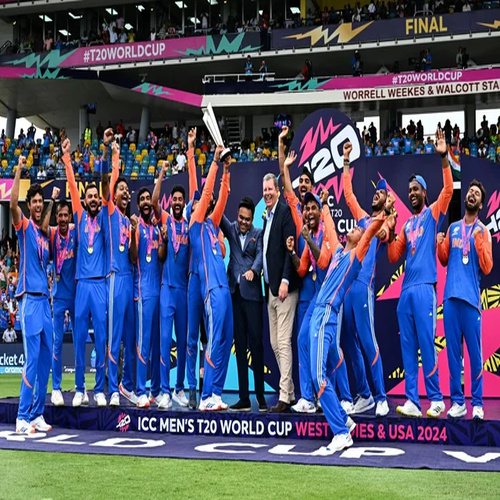
Lessons in Triumph: Comparing India’s Tactics in the 2023 World Cup Final and WT20 2024 Final
India’s approaches in the 2023 ODI World Cup Final and the WT20 2024 Final reflect contrasting strategies that shaped the outcome of each game. While the 2023 Final saw India struggle against Australia’s disciplined execution and clever tactics, the WT20 2024 Final against South Africa showcased a bold and well-balanced approach that allowed India to seize control and ultimately lift the trophy.
Left-Hand-Right-Hand Combo: A Tactical Edge
A key distinction between the two finals was India’s use of a left-hand-right-hand batting combination in the WT20 Final, which was missing in the 2023 ODI Final. India’s batting order in the T20 Final featured Rohit Sharma and Virat Kohli opening the innings, with Rishabh Pant, a left-hander, coming in at three, followed by Suryakumar Yadav at four and Axar Patel at five. This arrangement alternated between left and right-handed batters, allowing India to unsettle South Africa’s bowlers and maintain a more dynamic approach.
In contrast, the 2023 ODI Final’s batting order only included Ravindra Jadeja, a left-hander, positioned lower in the order at number 7. This limited the effectiveness of the left-right combination, giving Australia’s bowlers an easier rhythm to maintain. The absence of left-right alternation allowed Australia to bowl to set plans and employ tighter fielding, leading to a boundary drought that lasted as long as 97 balls. Both Kohli and Rahul are primarily controllers, and none of them were too willing to take risks, which Australia used to their advantage. This defensive strategy hindered India’s momentum and allowed Australia to stay in control.
Sixth Bowling Option: The Hardik Factor
India’s WT20 2024 Final lineup benefitted immensely from the inclusion of Hardik Pandya as a sixth bowling option. Hardik’s impact was immediate, breaking South Africa’s momentum with the crucial wickets of Heinrich Klaasen and David Miller. Arshdeep Singh was also utilized effectively, claiming the crucial wicket of Quinton de Kock and adding essential variety to India’s bowling attack. This flexible bowling setup allowed India to apply pressure in the middle overs, limiting South Africa’s scoring options during critical stages of the game.
In the 2023 ODI Final, India’s lack of a sixth bowling option restricted their tactical responses to Australia’s batting approach. With only five bowlers, India had fewer options to rotate or add variety, making it difficult to break partnerships or change the game’s pace.
Captaincy Gambles: Risks and Outcomes
Key captaincy decisions impacted the course of both finals, with notable gambles in the WT20 Final. One such gamble was giving Jasprit Bumrah two overs in the powerplay—a departure from his usual single-over opening role. This adjustment did not yield the desired result, as Bumrah was unable to maintain the control he typically exhibited in his standard position. Another tactical misstep in the WT20 Final was assigning nine overs to spinners instead of the more standard eight, a decision that nearly allowed South Africa back into the game. A similar tactical misstep in the 2023 Final was giving Mohammed Shami the new ball, when he had been a first-change bowler throughout the tournament. Although he did take a wicket, he leaked runs, and more importantly, this decision reduced the effectiveness of Mohammed Siraj, who had been in great form.
However, India’s captaincy in the WT20 Final was also marked by effective choices that balanced out these risks. The placements of Arshdeep and Hardik were well-timed, while smarter field settings added another layer of pressure on South Africa’s batters. In contrast, the 2023 ODI Final saw more defensive field settings from India, which Australia’s batters were able to exploit by rotating strike and finding gaps. These overly cautious field placements allowed Australia to dictate terms, leading to an increased scoring rate and prolonged pressure on India’s bowlers.
Luck and Individual Brilliance: The Final Ingredients
India’s victory in the WT20 Final also came down to moments of brilliance and a touch of luck. Suryakumar Yadav’s spectacular catch exemplified athleticism and quick reflexes, shifting momentum back in India’s favor at a crucial juncture. Such individual contributions, combined with sound strategy, helped India withstand South Africa’s challenges.
In sum, India’s contrasting performances in these finals reflect the importance of strategic versatility, solid field settings, and sharp decision-making under pressure. The calculated adjustments and well-executed tactics in the WT20 Final enabled India to break their trophy drought, proving their evolution as a team capable of learning from past experiences